Artificial intelligence is no longer just a tool - it is reshaping how we live, work, and relate to one another. As more decisions are handed over to algorithms, their influence becomes deeply embedded in our everyday lives. While AI systems are designed for the many, their development remains concentrated in the hands of a few institutions - undemocratic and profit-driven, deciding our future behind closed doors.
“Latent Collective” is a call to reclaim agency in the age of AI. It marks the beginning of a collective and democratically shaped AI future. At the heart of the project is a neural network trained not in isolation, but through open collaboration. Together we teach it to generate a diverse set of images of hands-symbols of agency, care, resistance, and connection.
Concept
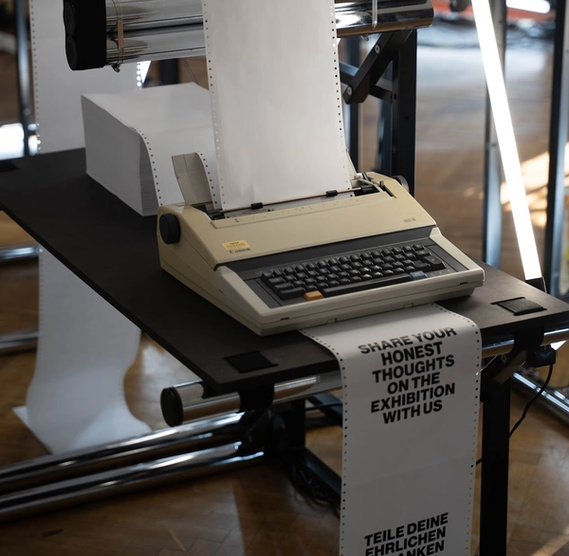
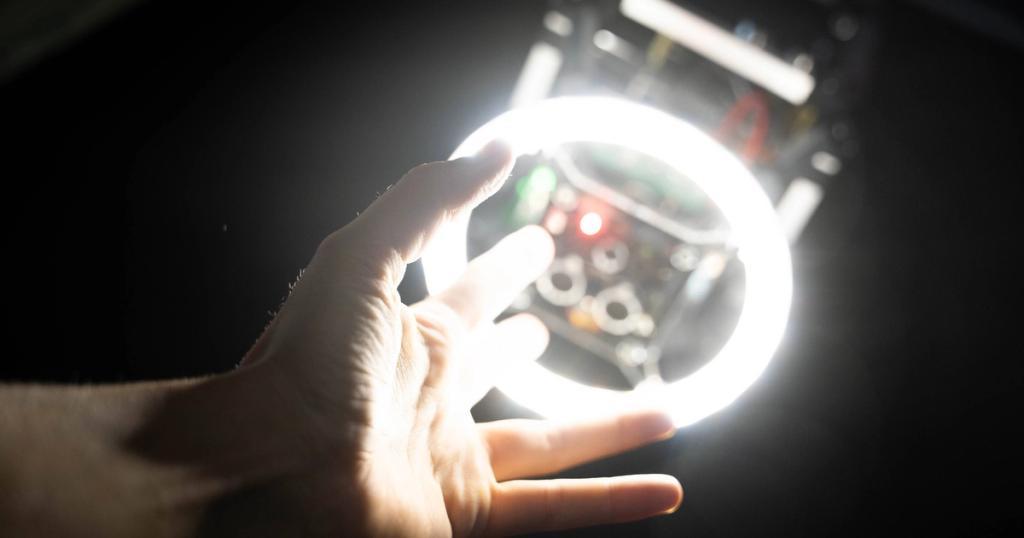
Training data lays at the core of any AI model. To co-create a truly diverse model the installation offers visitors to add their own hands to the data, by capturing a short video of their hands to train a primitive exemplary model. Distance sensors, lights, and screens dynamically respond to each visitor’s presence, illustrating the principles of democratic AI and inviting them to become part of a shared, co-owned model.
Image
The Model
The neural network trained through this installation forms the core of the project. It is an image-to-image model based on a Generative Adversarial Network (GAN) architecture, producing 64×64-pixel black-and-white images. Each time new training data is added, the model is retrained for 100 epochs. Designed for efficiency rather than maximum output quality, it can be re-trained within seconds. Within the installation, the 64-dimensional latent space of the model is visualized in three dimensions using a t-SNE dimensionality reduction algorithm, allowing visitors to explore how the model organizes and interprets its learned representations.
Credits
Many thanks to everybody involed: Angela Neubauer, Alan Schiegl, Chiara Kanya, Matthias Pfeffer, Martin Grödl, Minna Rothbart, Tim Ficht, Johannes Mayer, Stephanie Rentscher, Nina Gstaltner, Nicole Schadensteiner Anab Jain, Niko Heep and Stefan Zinell